Flora Detail
| Common Name | Green tree pincushion, kreupelhout, luisies (Afr.) |
| Family | Proteaceae (Protea Family) |
| Date Observed | 18-09-2022 |
| Category | Bushes |
|---|---|
| Catalogue No. | 4427RGu |
| Flowering Time | Spring,Summer |
| Colour | Yellow |
| Locations Observed | |
| Estuary | Few |
| Koppie | Few |
| Nature Reserve | |
| Small Holding | Few |
| Village | Few |
| Greater Rooiels | Many |
Leucospermum conocarpodendron subsp. viridum
Information
Green tree pincushion, kreupelhout, luisies (Afr.) Near threatened.

The green tree pincushion is
absolutely spectacular when covered in masses of bright yellow flowers on the
slopes of our mountains and in the village.
The tree can grow up to 5 m and 6
m across, but hardly does in the Rooiels Corridor due to too frequent veld
fires. The thick trunk has corky bark, which make the larger trees fire
resistant.
The flowerheads are very showy up
to 10cm in diameter, the butter-yellow flowers large up to 5cm long and the styles
up to 5.5cm long.
The leaves are deep green and
smooth, sometimes with a slightly hairy fringe on the edge.
POLLINATORS & SEED CARRIERS
The main pollinators are the Cape
Sugarbirds. Some bees and wasps also zoom in for some nectar and pollination – adding
food on the menu for various birds.
The hard nut-like seeds are covered
in an elaiosome – a nutritious, fleshy film.
Ants carry the seeds to their
nests, where the young ants feed on the elaiosome. The seeds safely planted, now
wait for a trigger from nature to germinate. That trigger would be a fynbos
fire, ash and rain.
WHAT’S IN A NAME?
Leucospermum is derived from the
Greek words leukos meaning white, and sperma meaning seed.
Conocarpodendron means 'the tree
bearing cone-shaped fruits'. Viridum refers to the green colour of the leaves.
“Kreupelhout” was already in use
by 1680 and refers to the bent (crippled) branches.
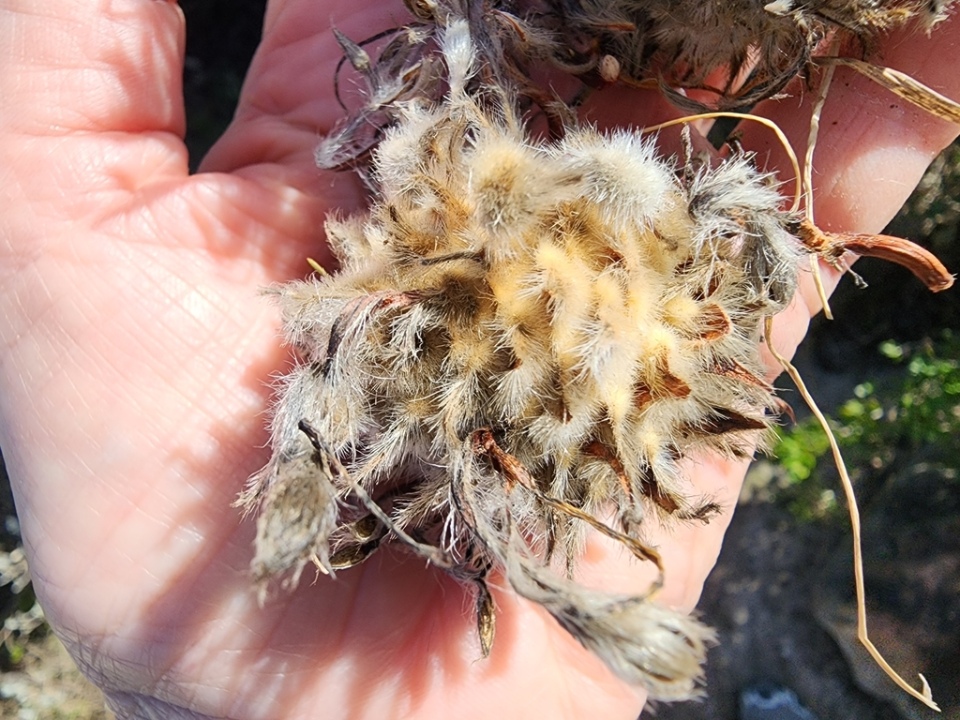
When looking at a close-up of the
flowers, one can understand why they are sometimes called “luisies”.
USES
The tree trunks were used extensively
for fire wood in the old days and some of the wood was used to make the felloes
of ox-wagons. The bark was used for tanning leather.
DISTRIBUTION
This species occurs from the Cape
Peninsula to Stanford, although most of its habitat has been destroyed due to
urbanization and alien vegetation.
It grows mainly in the lowlands
on well drained, sandstone-derived soils, often in fairly dense stands. See the
slopes above the R34.
Another species with grey leaves L.
conocarpodendron subsp. conocarpodendron grows on the northwestern side of the
Cape Peninsula.
STATUS
Near threatened (NT) due to agricultural and urban expansion, forestation
and alien plant invasion. All the chopping out for fire wood right into the 20th
century didn’t help either.

Click to find out more on iNaturalist