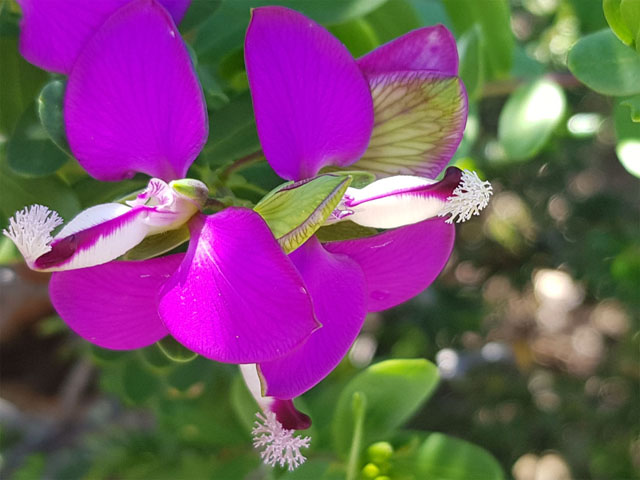
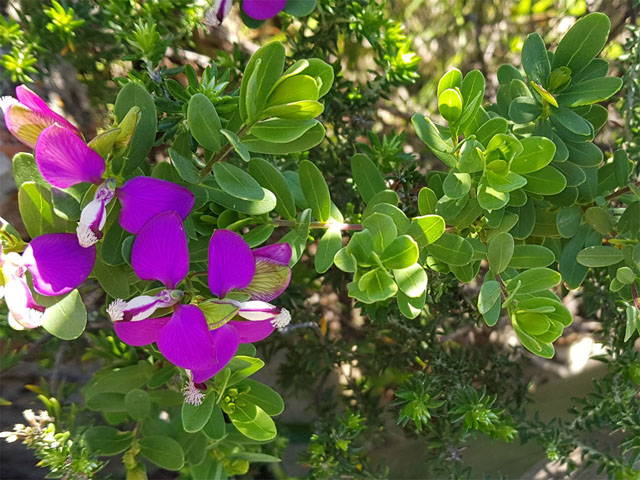
Flora Detail
| Common Name | Septemberbush |
| Family | Polygaladeae (Milkworts) |
| Date Observed | 20-09-2021 |
| Category | Shrubs |
|---|---|
| Catalogue No. | 3330RG |
| Flowering Time | Spring,Summer |
| Colour | Pink to Mauve |
| Locations Observed | |
| Estuary | Few |
| Koppie | Few |
| Nature Reserve | Few |
| Small Holding | |
| Village | |
| Greater Rooiels | |
Polygala myrtifolia var. myrtifolia
Information
Sweet Pea Shrub
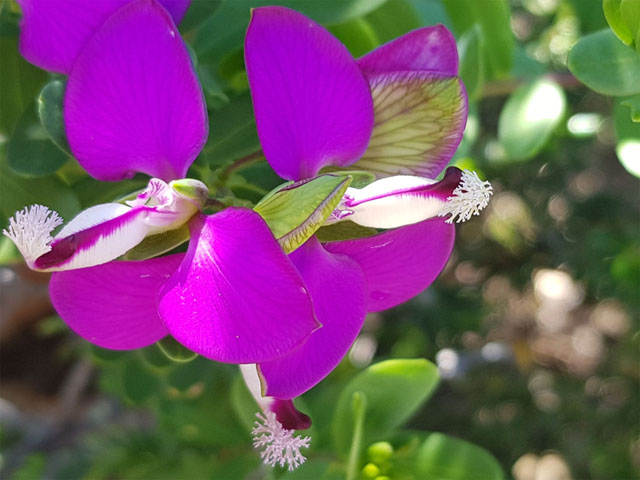
Polygala myrtifolia, the myrtle-leaf milkwort,[1] is an evergreen 2-4m tall South African shrub or small tree found along the southern and south-eastern coasts, from near Clanwilliam in the Western Cape to KwaZulu-Natal. It is a fast-growing pioneer plant, a typical fynbos component, and may be found on dunes, rocky places, along forest margins, beside streams, and in open grassland. It belongs to the milkwort family of Polygalaceae.
The thin, oval, mucronate leaves, 25–50 mm long and up to 13 mm wide, are arranged alternately and have entire margins – some forms of P. myrtifolia have thin, needle-like leaves. The attractive mauve sweetpea-like flowers, which close at night, may also be pink, crimson or white, and have a characteristic brush-like tuft protruding from the keel. For pollination an intricate piston mechanism is used.[2] The fruit is an oval, brown, dehiscent capsule which is narrowly winged. The species is often cultivated in South African gardens.
Etymology
Polygala is interpreted as 'much milk' since the plant was thought to stimulate milk production in European cows – myrtifolia translates as 'myrtle-shaped leaves'.
Medicinal properties
The species is noted for its antibacterial and antifungal properties. Research conducted by the University of KwaZulu Natal found that aqueous extracts of P. myrtifolia proved effective against Candida albicans.[4]
Environmental impact
P. myrtifolia has become naturalised in coastal areas of California, New Zealand and Norfolk Island. In Australia, it is a significant environmental weed in coastal districts of Victoria and South Australia, and a moderately important environmental weed in New South Wales, Tasmania and Western Australia. In the 2010s, it was recently listed as a priority environmental weed in parts of Queensland.[5]
References
- ^ USDA, NRCS (n.d.). "Polygala myrtifolia". The PLANTS Database (plants.usda.gov). Greensboro, North Carolina: National Plant Data Team. Retrieved 11 October 2015.
- ^ Westerkamp, C.; Weber, A. (1997-10-01). "Secondary and tertiary pollen presentation in Polygala myrtifolia and allies (Polygalaceae, South Africa)". South African Journal of Botany. 63 (5): 254–258. doi:10.1016/S0254-6299(15)30762-6.
- ^ "Polygala Tourn. ex L". Plants of the World Online. Royal Botanic Gardens Kew. Retrieved July 5, 2020.
- ^ "Polygala myrtifolia | PlantZAfrica.com". www.plantzafrica.com. Retrieved 2017-08-04.
- ^ "Scientific Name Polygala myrtifolia L." Weeds of Australia: Biosecurity Queensland Edition. Queensland Government. Retrieved 2019-02-21.