Flora Detail
| Common Name | Wild aster, dwarf Felicia (Eng.); wilde-aster, bloublombossie (Afr.) |
| Family | Asteraceae |
| Date Observed | 20-09-2021 |
| Category | Shrubs |
|---|---|
| Catalogue No. | 3333RG |
| Flowering Time | Spring,Summer |
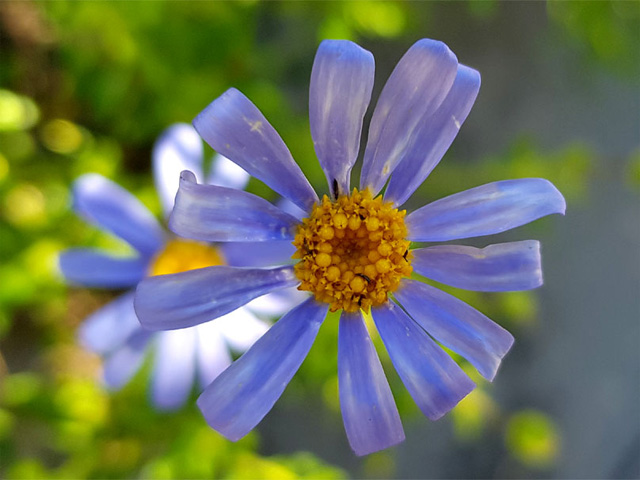
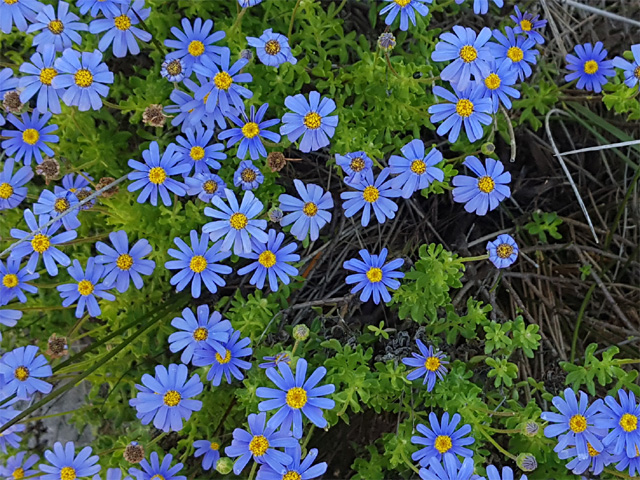
| Colour | Blue to Purple |
| Locations Observed | |
| Estuary | |
| Koppie | |
| Nature Reserve | Few |
| Small Holding | |
| Village | |
| Greater Rooiels | |
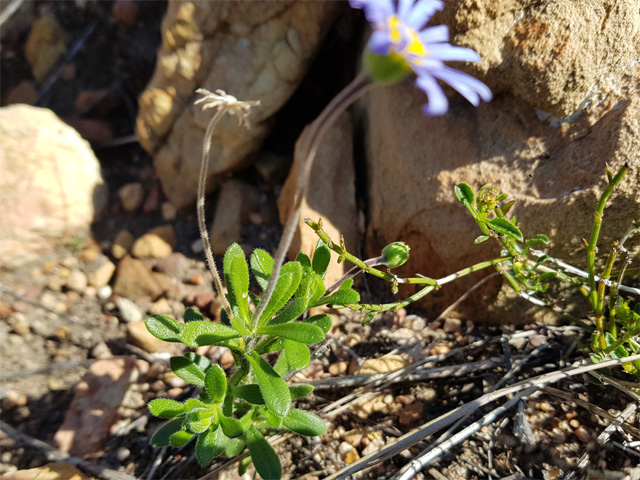
Felicia amoena ssp. latifolia
Information
Wild aster, dwarf Felicia (Eng.); wilde-aster, bloublombossie (Afr.)
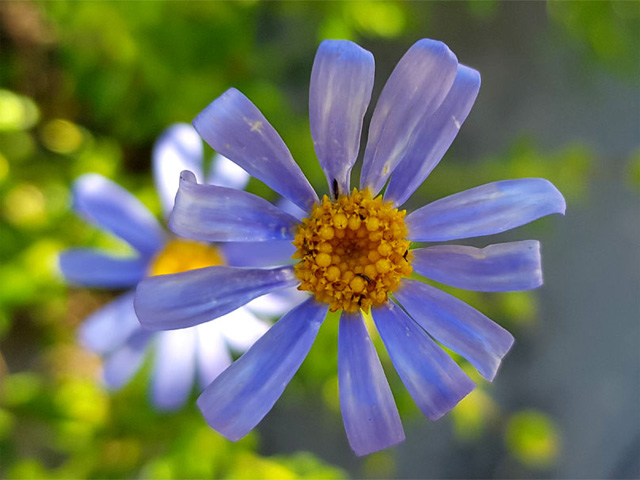
As far as known, the first specimen of this daisy species was collected in 1826, where the road from the Potberg crosses the Breede River, by Cape Town organ player Ludwig Beil. It is now assigned to the subspecies latifolia. A plant collected by Johann Franz Drège at Riebeek-Kasteel, was described by Augustin Pyramus de Candolle in 1836, who called it Agathaea stricta, is now assigned to subsp. stricta. The first specimen now assigned to subspecies amoena was collected from Hout Bay on the west coast of the Cape Peninsula by Christian Ferdinand Friedrich Krauss in 1838. It was described in 1843 by Carl Heinrich 'Bipontinus' Schultz, who named it Agathaea amoena. In 1865, William Henry Harvey, who was a lumper, sunk Agataea in Aster, creating the combination Aster amoenus. He distinguished a slightly different specimen, that had been collected by Karl Wilhelm Ludwig Pappe, and named it after him Aster pappei. Harvey further distinguished Aster elongatus var. spathulaefolius in the same publication. Finally Harvey regarded De Candolle's specimen as a variety that should be placed under Christian Friedrich Lessing's species Aster adfinis (now Felicia dubia), creating the combination Aster adfinis var. stricta. In 1948, the eminent South African botanist Margaret Levyns created the combination Felicia amoena, that is still in use today. In his 1973 Revision of the genus Felicia (Asteraceae), Jürke Grau distinguished three subspecies: F. amoena subsp. amoena, F. amoena subsp. stricta, and his new taxon F. amoena subsp. latifolia. The species is considered to be part of the section Neodetris.[2]
The species epithet amoena means "beautiful" or "pleasing" and is said to refer to the attractive flower heads.[3]