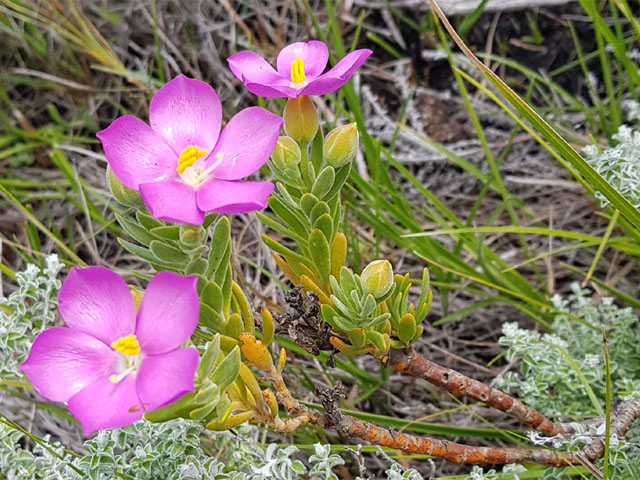
Flora Detail
| Common Name | Sea Rose |
| Family | Gentianaceae |
| Date Observed | 15-12-2021 |
| Category | Shrubs |
|---|---|
| Catalogue No. | 3365RG |
| Flowering Time | Summer |
| Colour | Pink to Mauve |
| Locations Observed | |
| Estuary | Many |
| Koppie | Few |
| Nature Reserve | Few |
| Small Holding | Few |
| Village | |
| Greater Rooiels | Few |
Orphium frutescens
Information
Sea-rose

ORPHIUM FRUTESCENS
Family
Gentianaceae – Orphium frutescens
Common Name
Sea Rose (Eng.); Teringbos (Afr.)
INTRODUCTION
The Sea Rose is found along the coast of the southwestern Cape, from
Lambert's Bay to George. Its habitat is near the seashore or in marshy brackish
flats. In Rooiels it flowers abundantly in the Nature Reserve and around the
estuary.
Each showy flower has five broad, glossy, slightly sticky pink petals.
Occasionally they are white. The anthers are bright yellow and coiled like
little barley-sugar sticks. Tiny openings at their tips allow the pollen to be
shaken out. (More about this in a moment.)
BUZZ POLLINATION
The flowers are pollinated by carpenter bees. The anthers open only in
response to the buzz of the bees' wings at approximately the note C. This has
even been demonstrated using a tuning fork!
This remarkable process is known as buzz pollination. It prevents the
pollen from simply blowing away in the famous Rooiels winds and ensures that it
is released only when a suitable pollinator visits.
Along comes the female carpenter bee. She hovers above the beautiful
pink flower—no response. Getting frustrated, she buzzes her little wings a
little faster until she reaches the right note. This causes the tiny pores in
the anthers to open, allowing her to shake out the pollen rather like using a saltshaker.
The hapless male carpenter bee has to find his pollen somewhere else.
HABITAT
The Sea Rose grows near the seashore or in marshy brackish flats. In
Rooiels you can find it in the Nature Reserve, around the rocky coastline and
in the estuary. It flowers mainly during the warmer months towards the end of
the year.
CONSERVATION STATUS
Status: Least Concern.