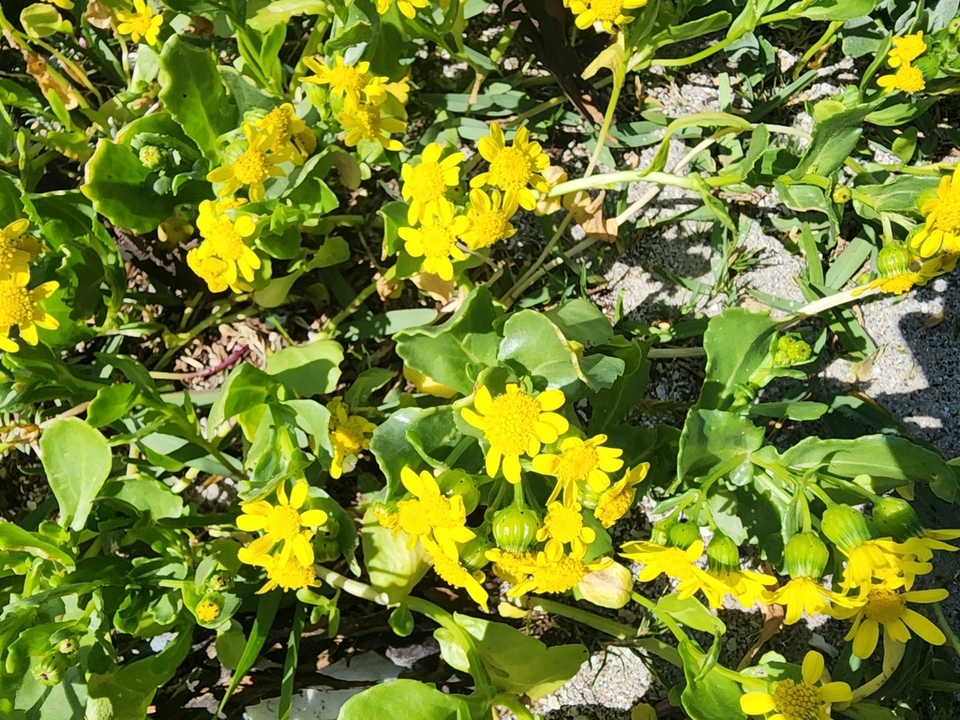
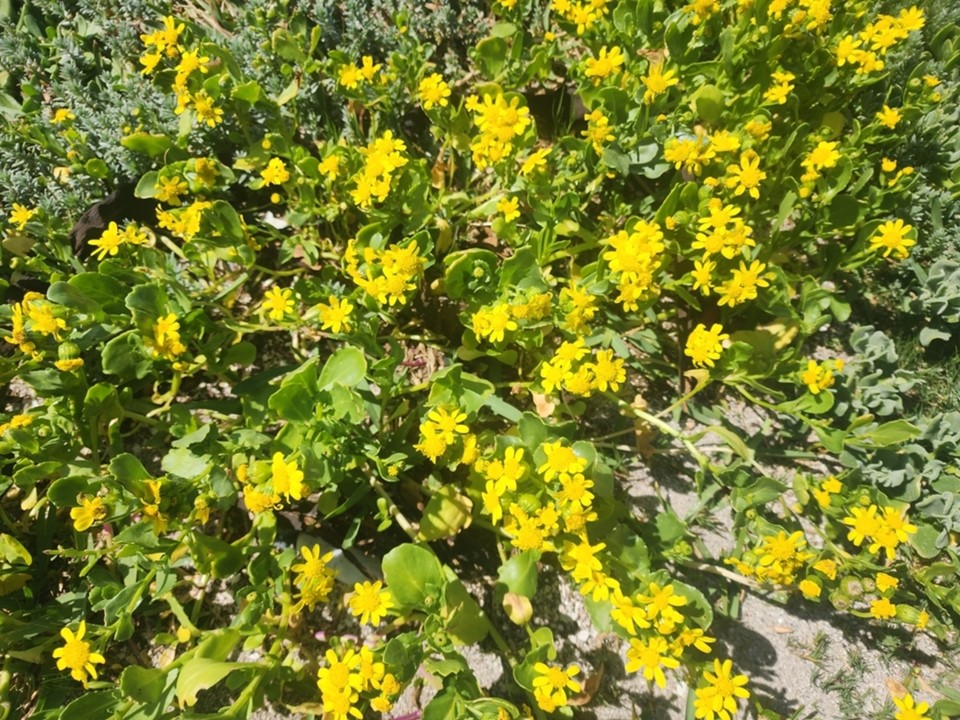
Flora Detail
| Common Name | Beach Ragwort |
| Family | Asteraceae |
| Date Observed | 20-09-2021 |
| Category | Shrubs |
|---|---|
| Catalogue No. | 3422RG |
| Flowering Time | Spring,Summer |
| Colour | Yellow |
| Locations Observed | |
| Estuary | |
| Koppie | |
| Nature Reserve | Few,Many |
| Small Holding | |
| Village | Few,Many |
| Greater Rooiels | |
Senecio maritimus
Information
Beach Ragwort
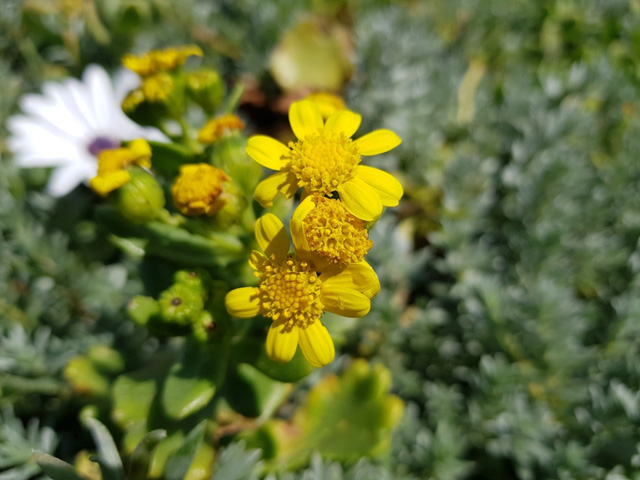
Description
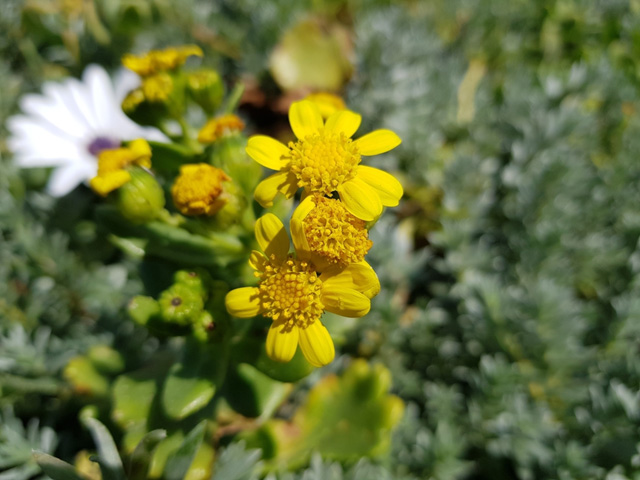
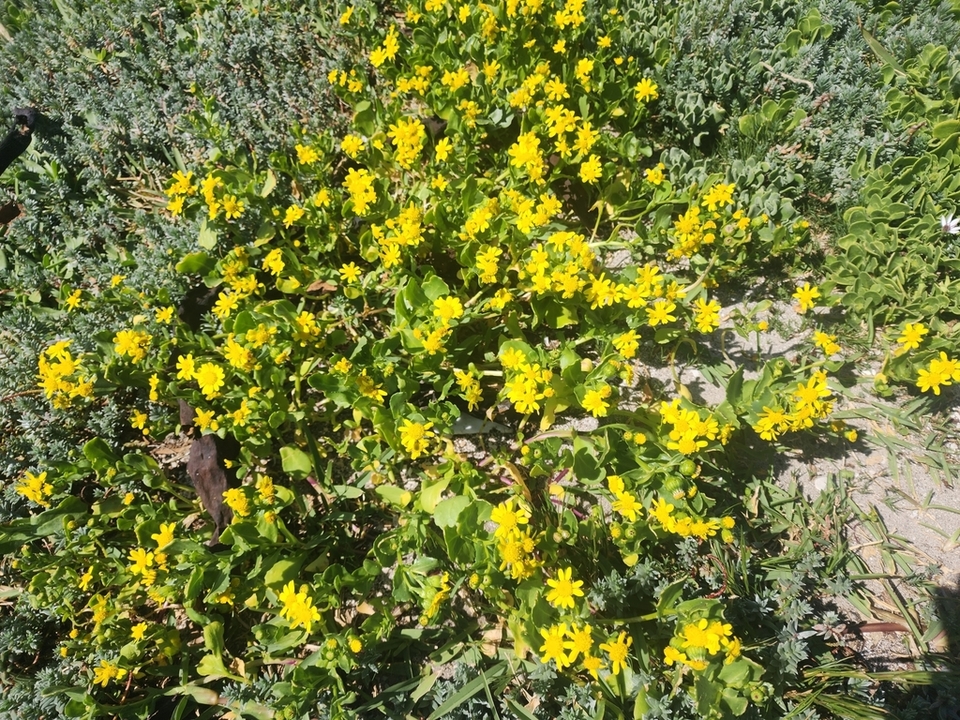
Senecio maritimus is a sprawling, hairless annual of 300 × 400 mm. The slightly fleshy leaves are inversely egg-shaped to oblong, the undersides of the leaves are hairy. The leaf-margins vary between smooth to somewhat toothed. The leaf-bases clasp the stem.
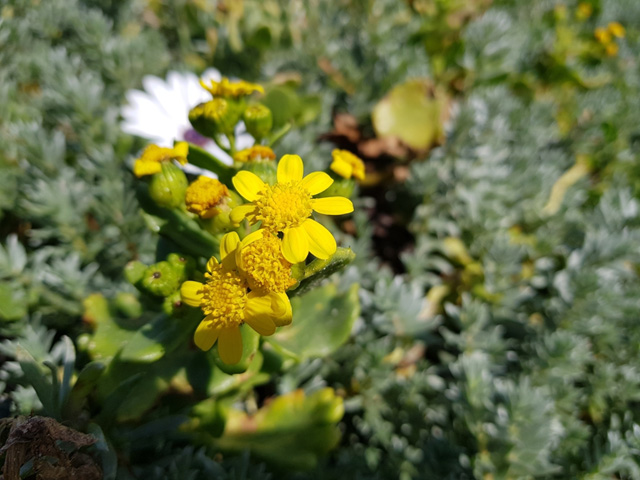
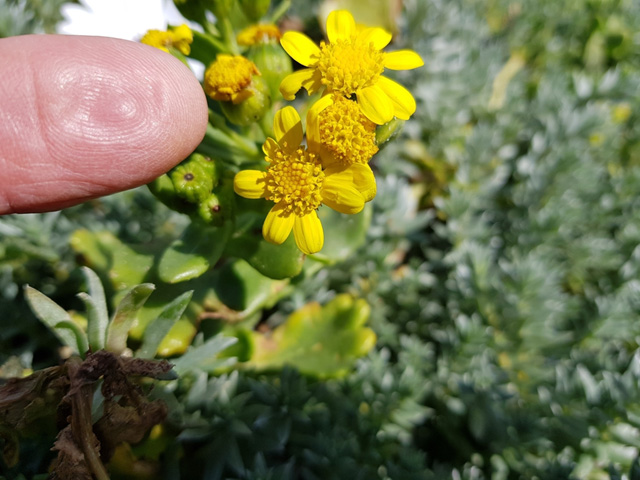
The flowerheads are in laxly branched clusters, each flowerhead consisting of both yellow disc and ray florets. Bracts are in a row with a few ones at the base of the involucre. Flowering is in late winter, spring and early summer, from August to December. Seed collection can be done from late spring, as of October.
Conservation Status
This species has a Least Concern (LC) status according to the Red List of South African plants website.
Distribution and habitat
Senecio maritimus is common near the sea shore, growing on coastal dunes and slopes and among rocks in the Western Cape, from Yzerfontein in southern Namaqualand along the coast to the Agulhas area in the Overberg.
Derivation of name and historical aspects
The genus name Senecio is derived from the Latin senex meaning ‘old man’, and alludes to the whitish grey-hairy pappus, which is often typical of this genus. The specific epithet maritimus, meaning ‘of the sea’, is descriptive of the sea-shore habitat.
The genus Senecio is a part of the daisy family or Asteraceae, which is the largest plant family in the world. Senecio is rather cosmopolitan and consists of approximately 1 200 spp. In southern Africa the genus is represented by more than 200 species.
Ecology
As with other species of Senecio, most notably the annuals S. arenarius and S. elegans, it is probably pollinated by honey bees.
Uses
No medical or cultural uses have been reported. It has the potential to become an excellent garden ornamental.
Growing Senecio maritimus
At the time of writing, no records exist on the cultivation of this species and, therefore, it cannot be unequivocally stated whether this species is easy to germinate or presents a challenge when it comes to its cultivation. This is especially true for freshly harvested seed for members of the Asteraceae family. In all likelihood, germination will come down to the following: sow the fine seed in a seed-tray filled with a free-draining medium. The seed can also be mixed with some sand, to make handling a bit easier and also to potentially minimize the risk of post-germination fungal-attacks because of too dense sowing.
Keep the sowing medium moist and do not allow to dry out totally. Once germinated, seedlings will be ready for transplanting into the garden once the second set of leaves have appeared. Struggling seedlings can be fertigated by using various organic or inorganic fertilisers, starting with a half strength diluted dosage. Gradually increases the dosages to full strength.
SANBI