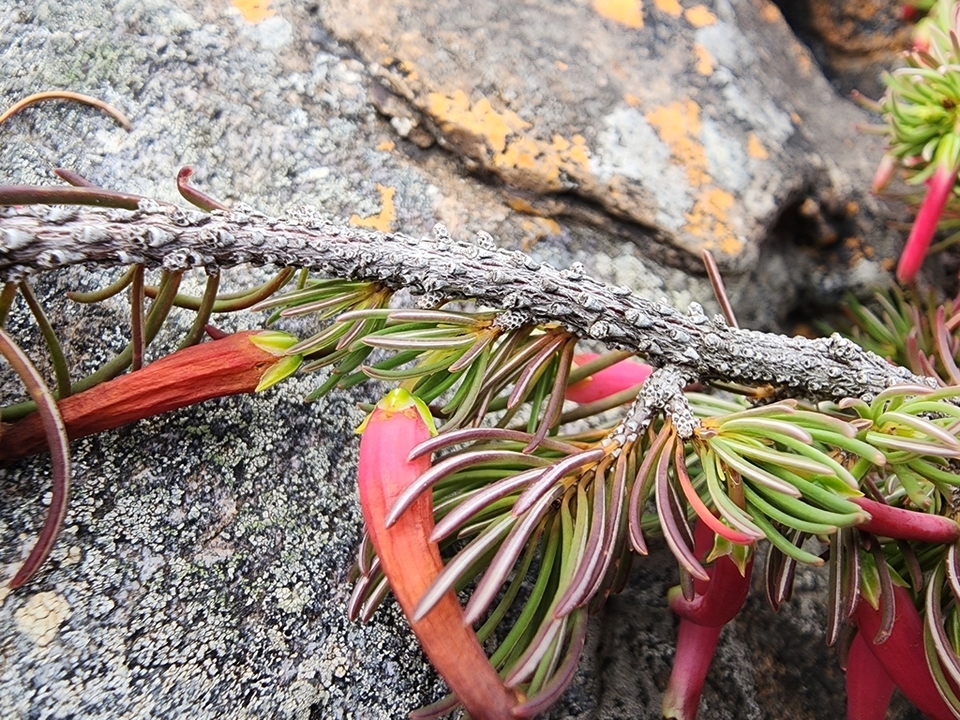
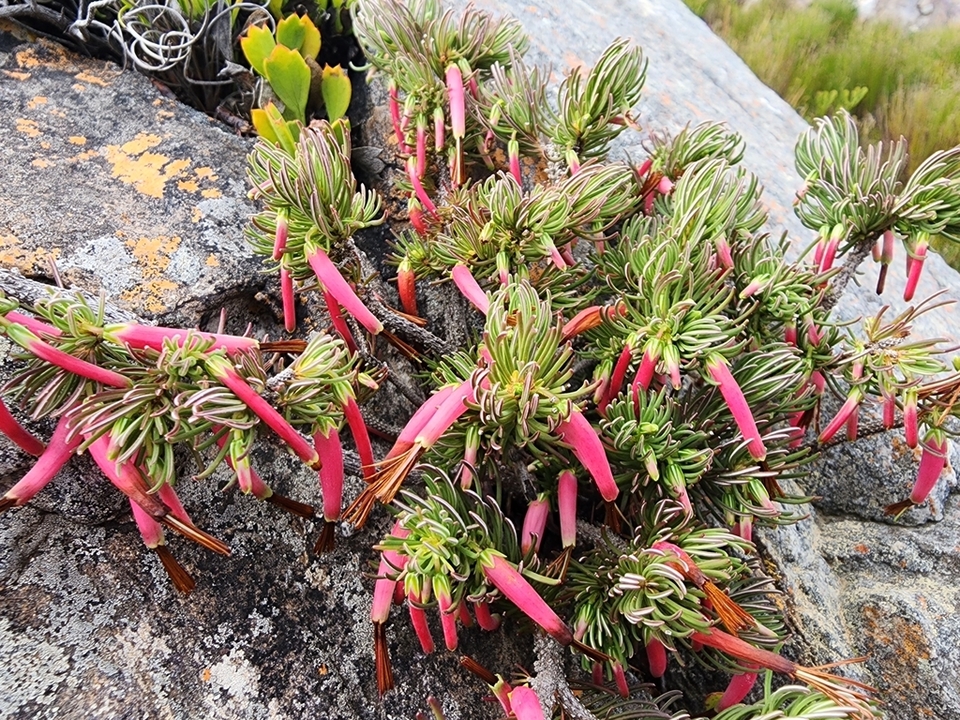
Flora Detail
| Common Name | Plukenet's heath; hangertjie (Afr.) |
| Family | Ericaceae (Heath Family) |
| Date Observed | 10-06-2021 |
| Category | Shrubs |
|---|---|
| Catalogue No. | 3303RGu |
| Flowering Time | Winter |
| Colour | Red |
| Locations Observed | |
| Estuary | Few |
| Koppie | Few |
| Nature Reserve | Many |
| Small Holding | Many |
| Village | Few |
| Greater Rooiels | Many |
Erica plukenetii
Information
Plukenet's heath; hangertjie (Afr.)
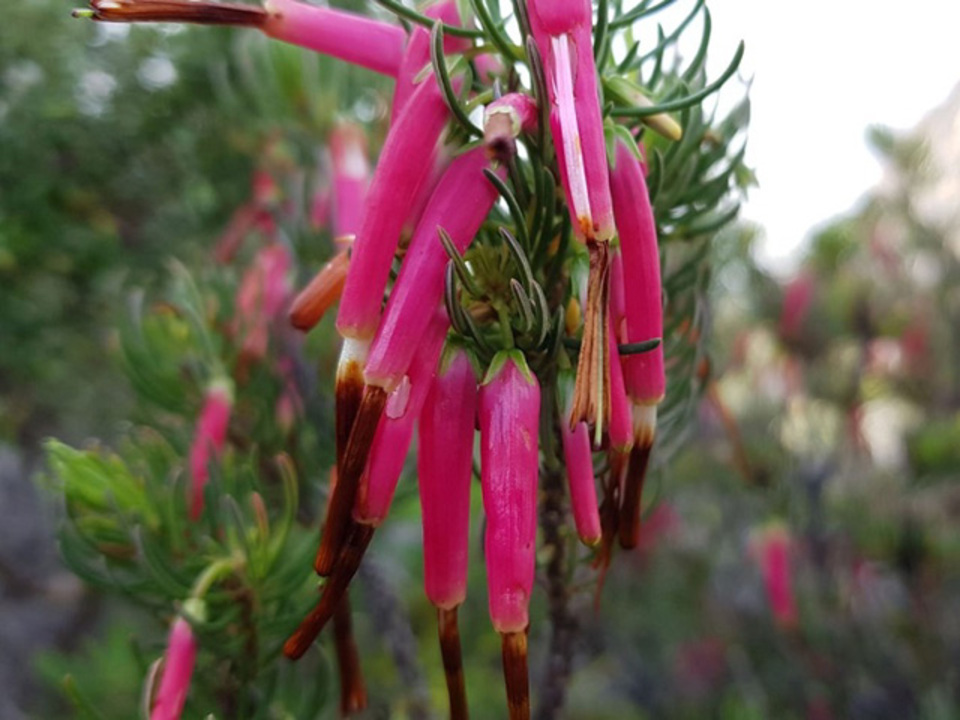
Erica plukenetii is a common species that is found on
mountain slopes throughout most of the Cape Floristic Region.
Description
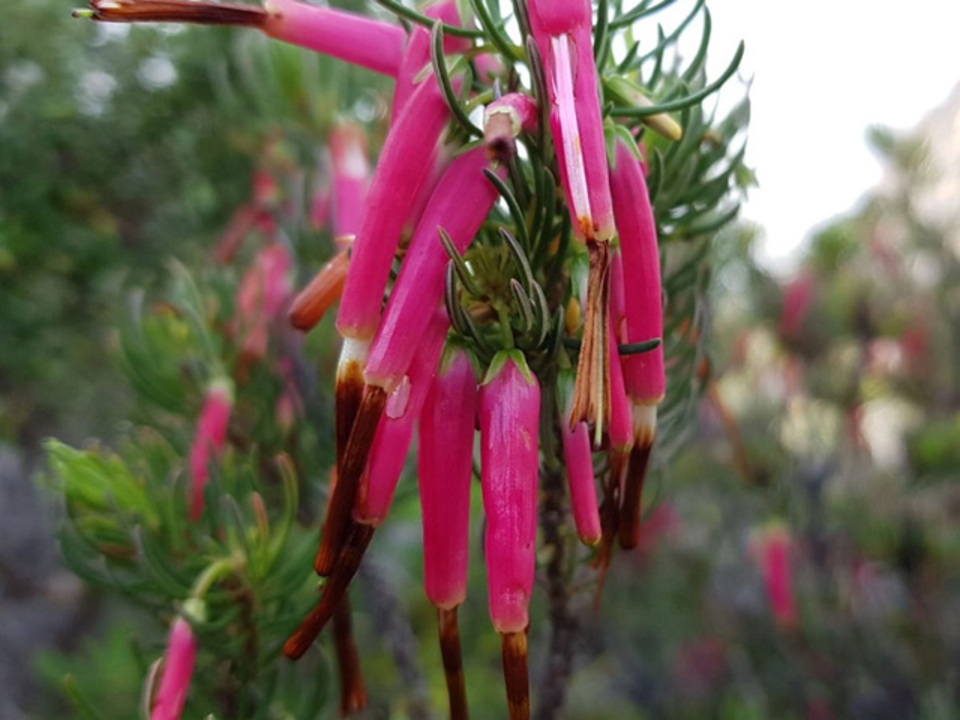
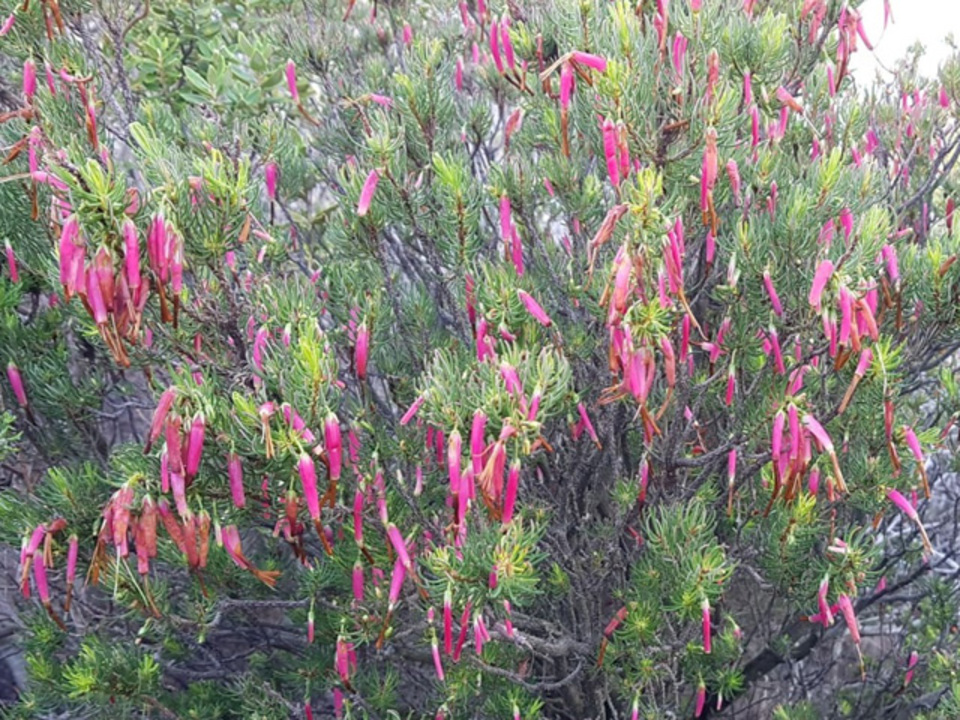
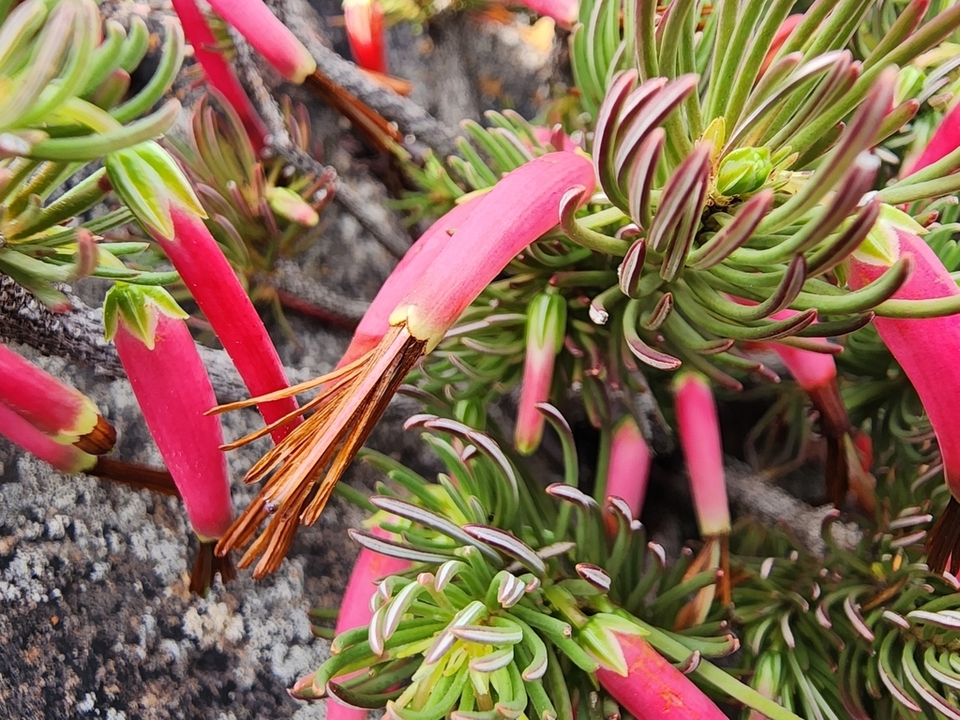
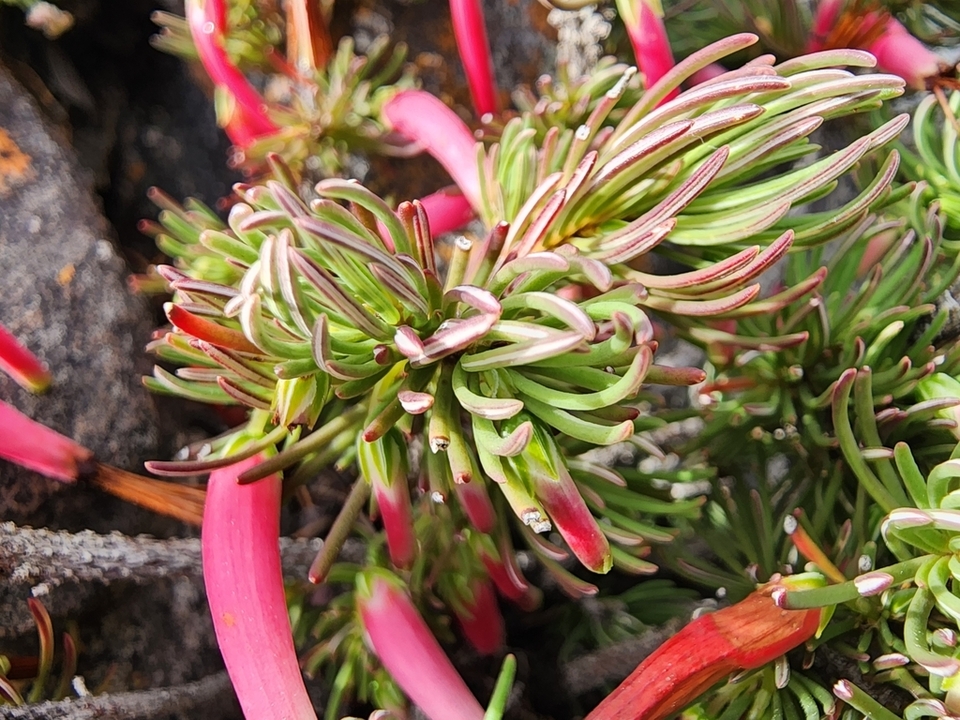
Erica plukenetii is an erect, sturdy shrub that grows up to
900 mm, but some forms may reach a height of up to 2 m. It has very
distinctive, long, thin, needle-like leaves that curve upwards, giving the
plants the appearance of small pine trees. It produces dense clusters of
hanging tubular flowers, the colour varies from white, pink, red, green to
yellow. The corolla is a partially inflated tube, varying from 7 to 18 mm long
with anthers that protrude far from the tube. These far-exserted stamens are a
particular feature of this species. It flowers at different times of the year
depending on the locality. On the Cape Peninsula it flowers mainly during late
summer-winter-spring (March to September).
Erica plukenetii is widespread, occurring in many areas that
are protected nature reserves and is, therefore, not regarded as threatened.
Distribution and habitat
Erica plukenetii has a wide distribution range, from the
Spektakelberg in Namaqualand eastwards to Mossel Bay and into the dry mountains
of the little Karoo. It grows on mountain slopes and flats amongst rocks and in
sandy, well-drained soils.
Derivation of name and historical aspects
Erica plukenetii was named by Linnaeus in honour of Leonard
Plukenet (1641-1706), who was a physician by profession but also a botanist of
high repute, gardener to Queen Mary and superintendent of the Hampton Court
garden. He published Phytographia in which he described and illustrated more
than 2 700 rare exotic plants. He was also the first author to mention a Cape
species of erica, in his book Almagesti Mantisssa Botanici published in 1700.
Ecology
This species is mainly found on mountain slopes, but also
grows on quartzite soils on lowlands near the sea. It is normally seed
producing (re-seeders); however, some also resprout.
The main variation in this species is the length and shape
of the corolla and sepals, size and texture of its leaves and in its growth
habit. The flowers vary from being long, thin and tubular to short and tubular.
The buds tend to be thin with the flowers changing shape and becoming inflated
as they mature. This species is often visited by sunbirds, which appear to be
the main pollinating agent.
Erica plukenetii is a hardy, attractive erica that is a good
garden subject. It also attracts birds to the garden.
When growing ericas in pots it is important to plant them in
the correct soil. The growing medium should be well-drained and acidic with no
manure and with low levels of phosphate. A well-drained, sandy loam with a pH
of between 5 and 6.5, containing 50% humus is recommended.
Erica plukenetii can be propagated by seed or cuttings. Seed
should be sown in autumn and treatment with smoke will improve germination,
resulting in a higher number of seedlings. Ericas are rooted using
semi-hardwood tip or heel cuttings in late summer to autumn or in spring. Treat
them with a rooting hormone for semi- hardwood cuttings and place in a
well-aerated medium under mist on heated benches. Source : SANBI
Click to find out more on Inaturalist