Flora Detail
| Common Name | Thirsty Heath |
| Family | Ericaceae (Heath Family) |
| Date Observed | 09-04-2023 |
| Category | Shrubs |
|---|---|
| Catalogue No. | 3540RG |
| Flowering Time | Autumn |
| Colour | Pink to Mauve |
| Locations Observed | |
| Estuary | |
| Koppie | |
| Nature Reserve | |
| Small Holding | |
| Village | |
| Greater Rooiels | Few,Many |
Erica sitiens
Information
Thirsty Heath
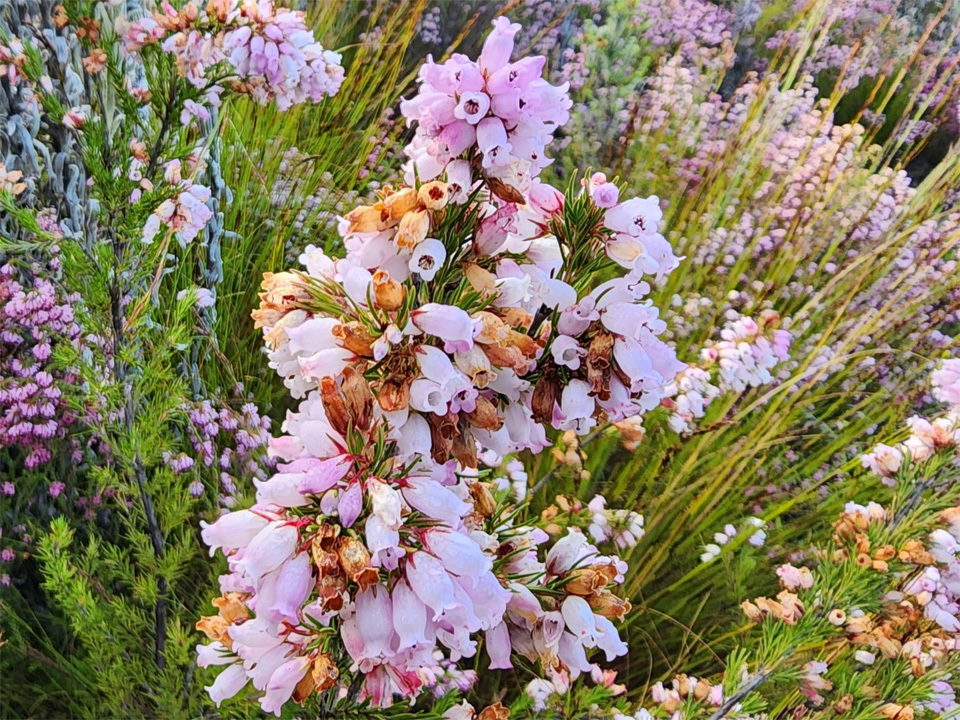
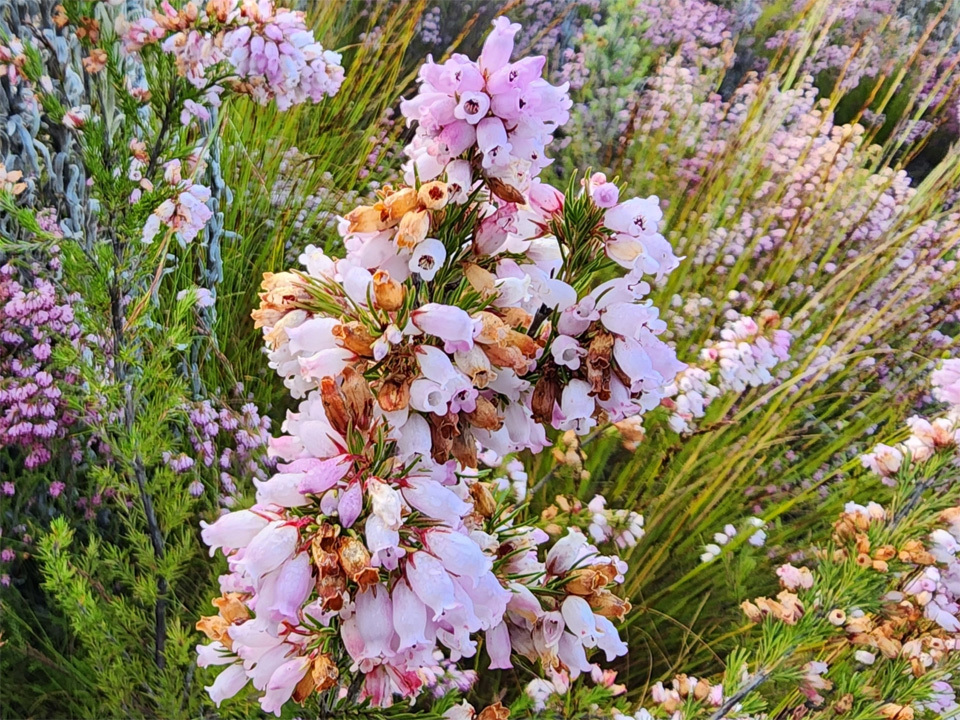
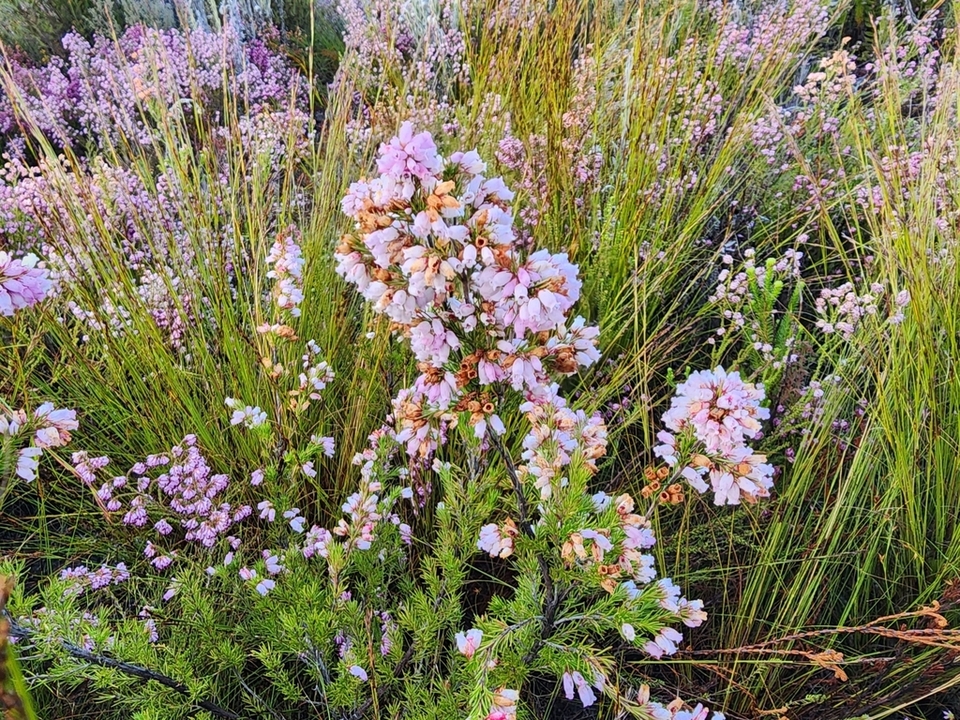
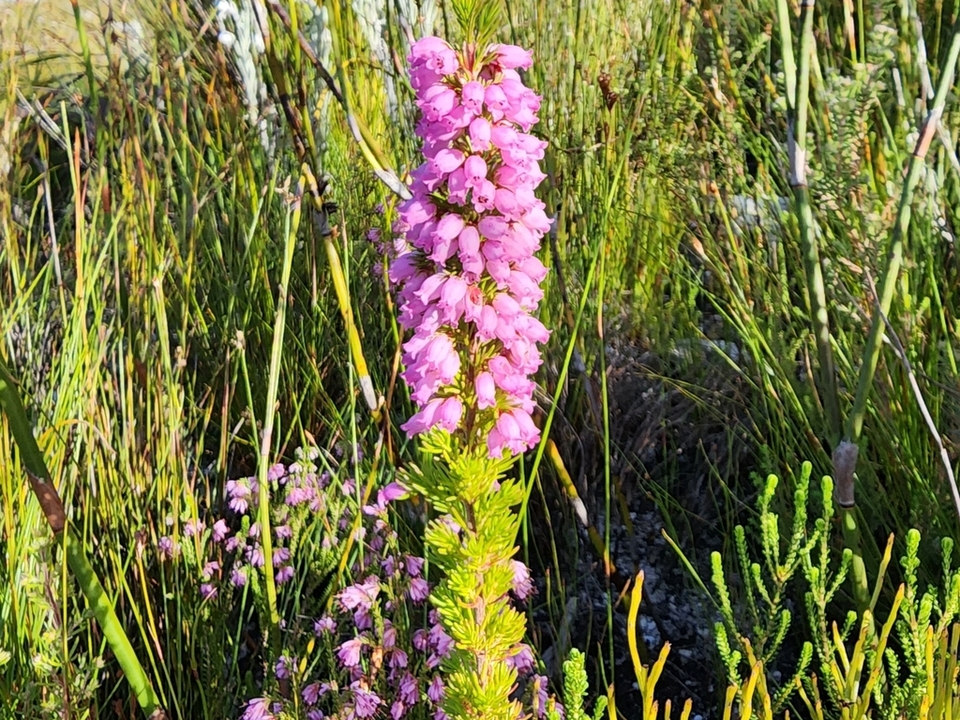
This upright or sprawling shrub becomes covered with masses
of pink, red or white flowers, or a combination of red with white lobes, during
the summer months.
Erica sitiens, pink form in the Erica Living Collection, Kirstenbosch.
Description
Erica sitiens varies in growth form, it can be very low
growing almost creeping or it can grow upright and reach a height of ± 600 to
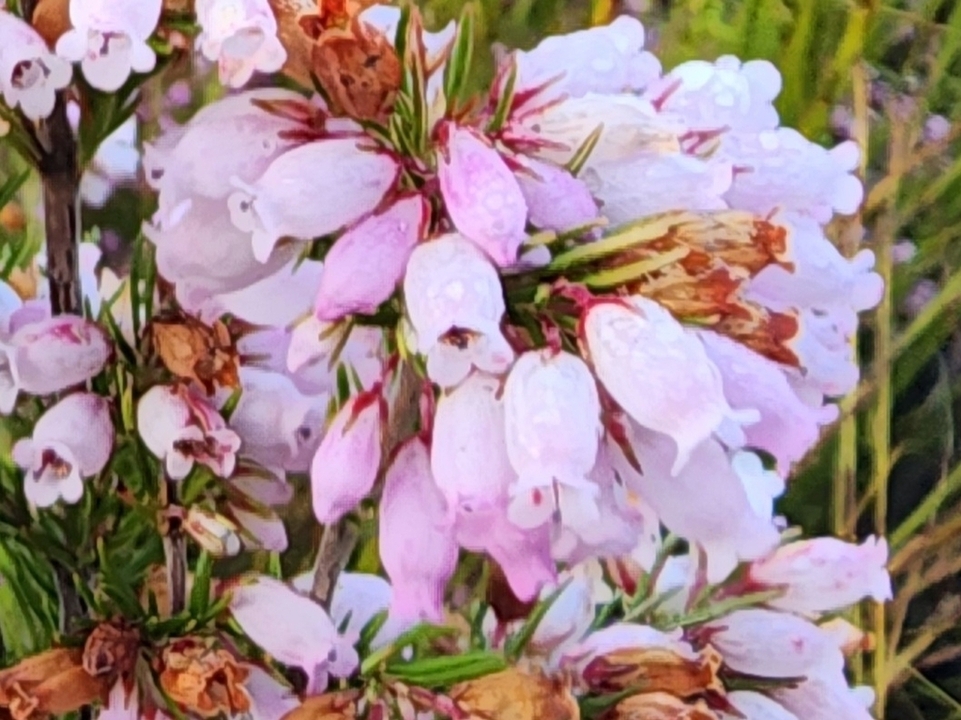
900 mm. The leaves are erect, straight and imbricate (overlapping like roof
tiles). The flowers are presented in fours, sometimes in threes or singly. The
corolla is small, 6 to 8 mm long, asymmetrically inflated, tubular, pale to
dark pink to red, sometimes white, sometimes red with white lobes. The anthers
are aristate, meaning they have horn-like appendages. Flowering is mainly in
summer.
Conservation Status
Erica sitiens is not threatened and was given an automated
conservation status of Least Concern (LC).
Distribution and habitat
Erica sitiens is a South African endemic and is found in the
Western Cape, from the Hottentots Holland to the Palmiet River Mountains where
it has established itself at altitudes from 300 to 1 000 m above sea level and
usually is quite common between the areas of Stellenbosch and Hermanus. This
plant never grows in marshy conditions, it grows happily in rocky outcrops,
which is possibly a clever method of obtaining extra moisture to survive dry
spells.
Derivation of name and historical aspects
The genus name Erica derives from the Latin word ereiko
which means ‘heath’ or ‘broom’. The specific epithet sitiens is Latin and means
‘thirsting’, this could refer to the fact that the plant does not grow in
marshy conditions or near water.
Ecology
The flowers were observed to be visited by insects, which
play a major role in carrying out the pollination process by moving from one
flower to the other. The seeds are small and can remain viable for long periods
within the soil in their natural environment, and usually germinate only when
the right temperature and soil moisture occurs, when conditions become
favourable for them.
Erica sitiens, pink form growing in Kirstenbosch.
Uses
This plant adapts well to container planting, however the
soil medium should be in the acidic range and it is essential that the pot
drains adequately. Erica sitiens makes an excellent companion plant when
planted in garden beds with other fynbos plants, such as species in the
Restionaceae, Proteaceae and Rutaceae families.
Erica sitiens in the Erica Living Collection, Kirstenbosch
NBG.
Growing Erica sitiens
Erica sitiens grows well in soil with a pH ranging from
5.5-6.7 and prefers a sunny position. Regular pruning will encourage new growth
and flowering, and the plant responds best to being fed with an organic liquid
fertilizer.
Sow seeds in autumn, around April and May, when the
temperature starts to drop naturally. Mix river sand and sifted composted pine
bark in a 50:50 ratio and add to a 100 mm deep seed tray and level it. Use fine
river sand to mix with the seeds and broadcast it on top of the levelled mix,
cover it lightly with some of the mixed sand. Keep the medium moist by watering
with a fine hose. The seeds will start to show signs of germination after about
2 months. The germination process can be enhanced by the application of smoke
(from fynbos plant material) which mimics the conditions in nature. Transplant
the seedlings into small pots once they are 10 mm in height.
Take ± 40-50 mm cuttings two months after flowering, take
heel or nodal cuttings from semi-hardwood growth, apply a rooting hormone for
semi-hardwood cuttings and plant them in a rooting medium of fine-milled bark
and perlite balls at a 50:50 ratio . Erica sitiens can be successfully
propagated in greenhouse conditions with a misting system and a constant bottom
heat of 24°C. Transplant the rooted cuttings into small pots (about 9 cm) in a
soil mixture of 8 parts bark and 3 parts sand, and water thoroughly. Feed with
an organic liquid fertilizer, preferably a fish emulsion type, every 2 weeks.
The cuttings will be ready to be planted after about 3 months.
It is best to plant out the young plants in the autumn or
early winter months when the weather conditions get cooler, to allow the plants
to establish before the start of summer. Erica plants naturally grow in poor
soils, but for best results should be regularly fed with diluted organic liquid
or small amounts of organic pellet fertilizers that are low in phosphorus.
Control mealybug and scale insects by applying an
appropriate pesticide product, organic pesticides are nowadays regularly
available and are a better option, follow the directions for application
closely.
Preventative measures such as not sowing seeds too densely
and maintaining good air circulation can prevent fungal attacks. Source : SANBI