Flora Detail
| Common Name | Branch Capespinach, (Eng),duinekool (Afr) |
| Family | Asphodelaceae |
| Date Observed | 20-09-2021 |
| Category | Ground cover |
|---|---|
| Catalogue No. | 1111RG |
| Flowering Time | Summer |
| Colour | White to Grey |
| Locations Observed | |
| Estuary | Few |
| Koppie | |
| Nature Reserve | Few |
| Small Holding | Few |
| Village | Few |
| Greater Rooiels | |
Trachyandra divaricate
Information
Branch Capespinach, (Eng),duinekool (Afr)
Description
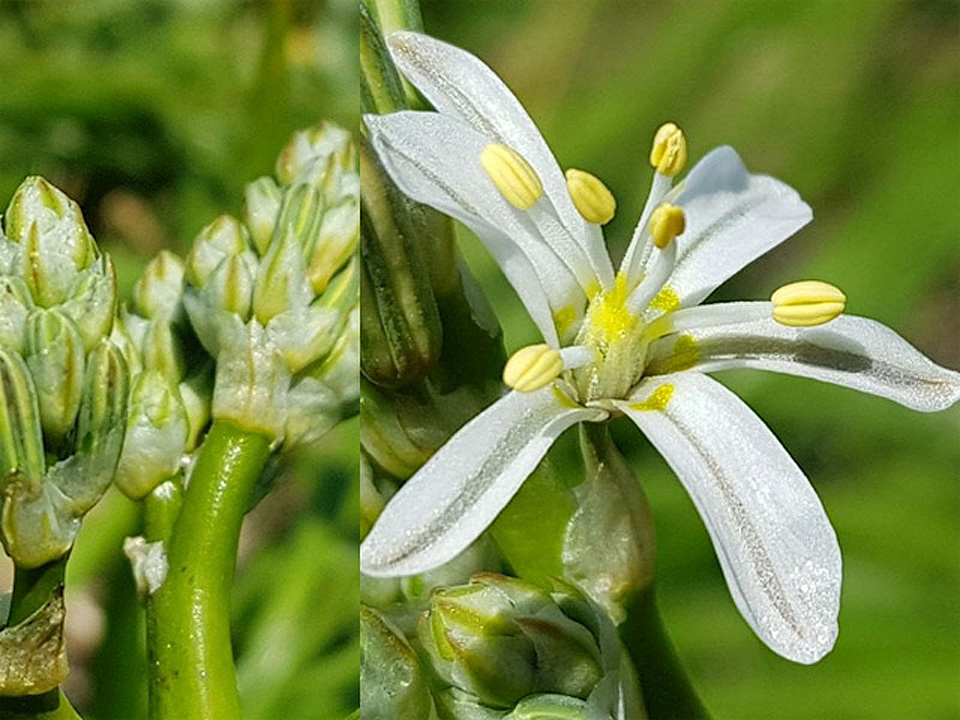
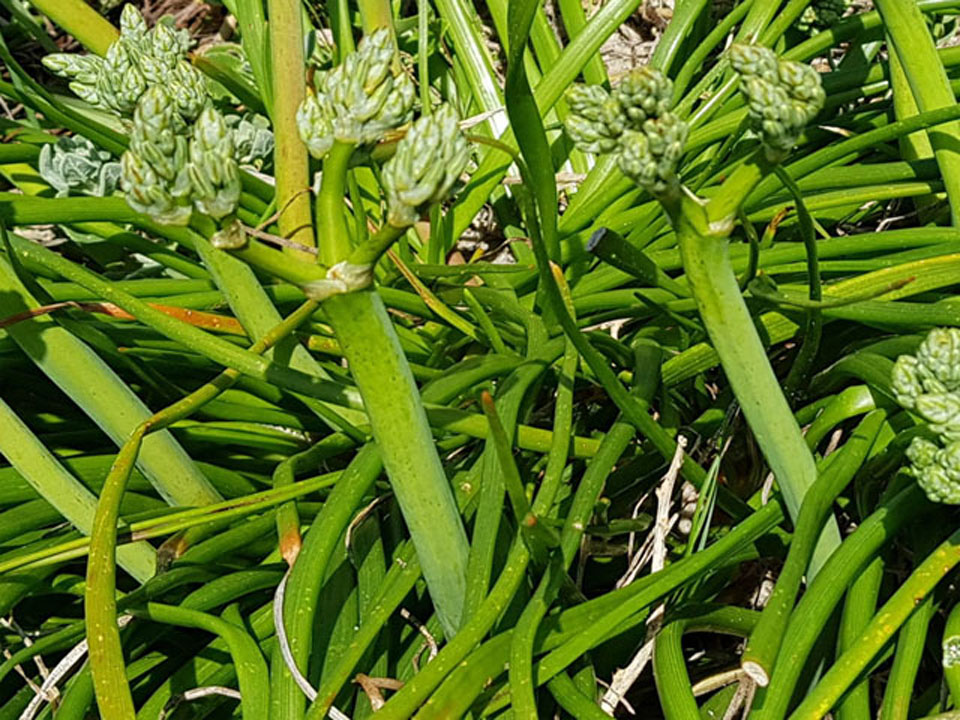
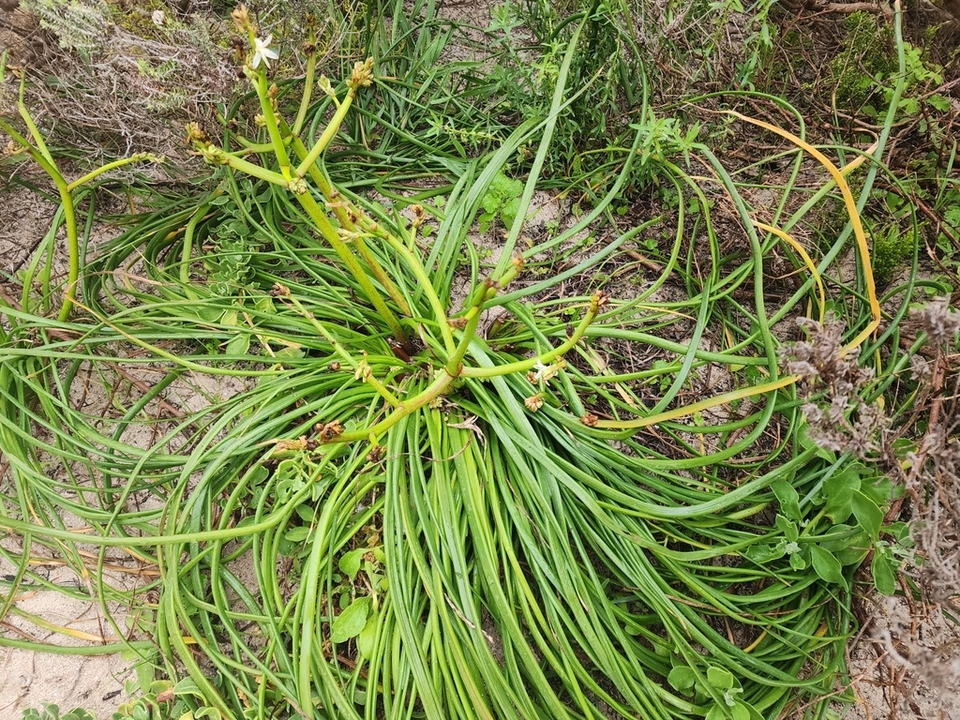
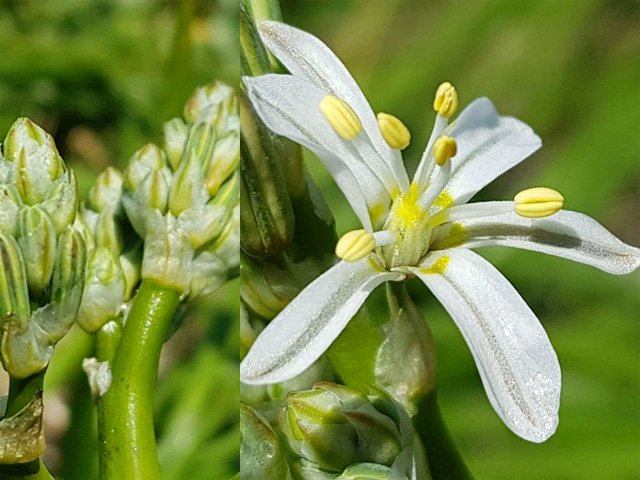
Trachyandra ciliata is an upright to sprawling herbaceous perennial up to 0.5 m heigh. Roots are wiry, often swollen and hairy. Leaves are linear, up to 100 cm x 4 cm, succulent, hairless or sometimes with hairs along the margins. Flowers are arranged into congested racemes, each lasting only a single day, tepals are white with a pink midrib and paired yellow spots near the base, usually curved backwards. There are 6 stamens with minutely hairy (scabrid) filaments. The capsule is round or cylindrical, hairless, usually recurved. Seeds are greyish black, sometimes with reddish brown streaking, and the surface has wart-like protuberances.
Flowering time: July to September.
Conservation Status
Least Concern (LC).
Distribution and habitat
Widespread, usually on coastal sands from southern Namibia to the southeastern Cape.
Derivation of name and historical aspects
The name Trachyandra is derived from the Greek words, trachy, meaning rough, and andro, meaning male, and refers to the scabrid (hairy) filaments of the stamens. There are ± 55 species that mainly occur in southern Africa, particularly the Western Cape, but some species extend into tropical Africa as far as Somalia. Trachyandra ciliata (ciliatus means finely hairy) is most similar to T. arenicola and T. falcata in the congested inflorescence. It was described by Linnaeus' son from a specimen collected by Carl Thunberg in the 1770s during his expeditions in the Cape.
Ecology
Trachyandra ciliata is common on sandy flats along the southwestern Cape coast. The plants are easily recognized from other similar species by the trailing, snake-like flower spikes. The fruiting stalks curve downwards very characteristically. Like all species in the genus, each flower lasts only a single day and is pleasantly scented. The flowers are pollinated by honey bees and solitary bees that collect pollen and possibly nectar. The seeds are shed during summer. Like other members of the family, each seed is covered by a thin papery skin which includes specialized cells that contain bundles of needle-like crystals of oxalic acid which probably function to deter seed predators.
Uses
Trachyandra ciliata is used as a vegetable. The flowering stalks are harvested before the flowers open and can be steamed or boiled in much the same way as asparagus, or cooked in a stew. Its use as a vegetable seems only to have been first recorded as recently as 1915 by Rudolph Marloth.