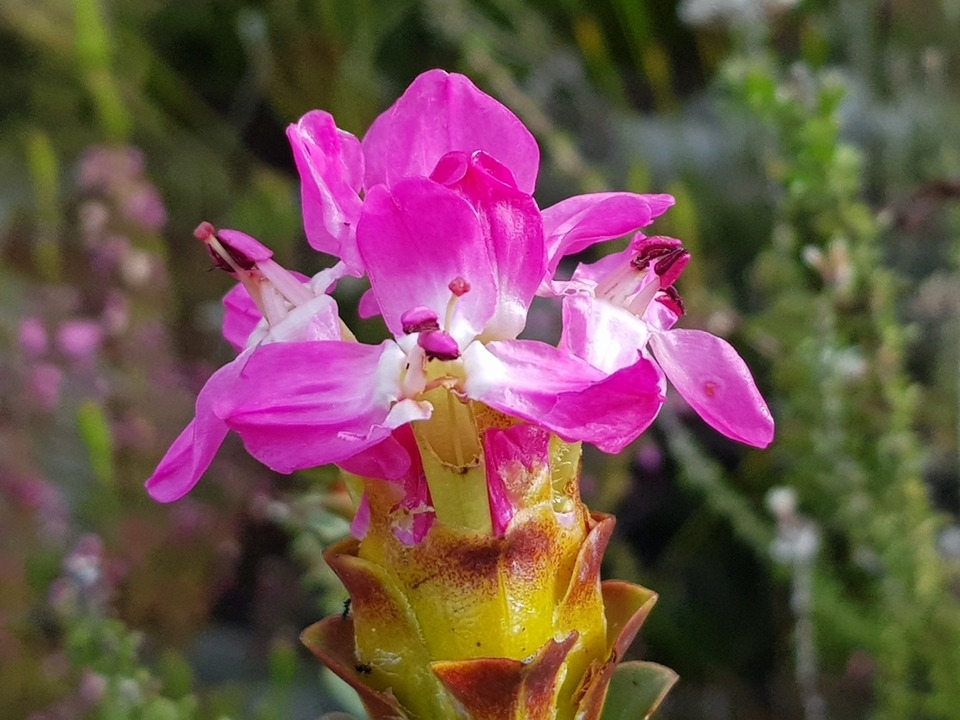
Flora Detail
| Common Name | Afr. Vlieëbos, Eng. Christmas candles |
| Family | Penaeaceae (Hard Pear Family) |
| Date Observed | 01-05-2023 |
| Category | Shrubs |
|---|---|
| Catalogue No. | 3551RGu |
| Flowering Time | Summer,Autumn |
| Colour | Pink to Mauve |
| Locations Observed | |
| Estuary | Not Observed |
| Koppie | Not Observed |
| Nature Reserve | Not Observed |
| Small Holding | Few |
| Village | Not Observed |
| Greater Rooiels | Few |
Saltera sarcocolla
Information
Afr. Vlieëbos, Eng. Christmas candles
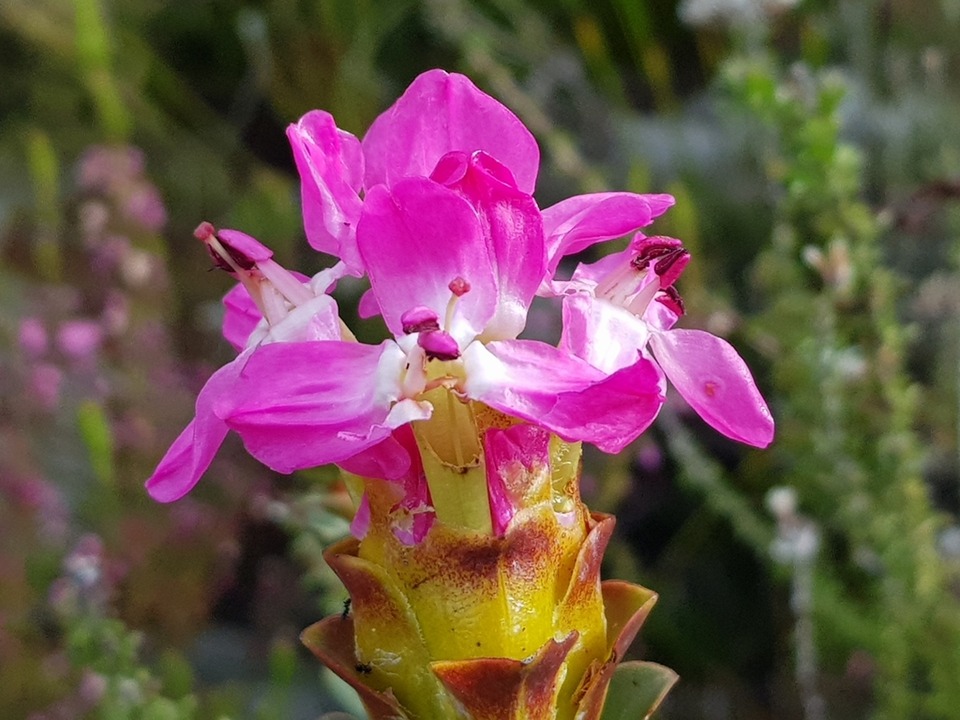
SALTERA SARCOCOLLA
Vlieëbos (Afr.); Christmas candles (Eng.)
Family: Penaeaceae
INTRO
SALTERA SARCOCOLLA
In the dry summer months, the vivid pink flowers of
Saltera sarcocolla stop hikers in their tracks.
“What is that?”
Locals call it Vlieëbos (Fly bush).
Nope — it doesn’t eat flies.
It simply traps them, along with other small insects, to protect its pollen for the sunbirds. Nature’s clever little bouncer.
DESCRIPTION
Saltera sarcocolla is a variable shrub, with its
appearance differing depending on where it grows. Some plants are small and
sparsely flowered, while others produce abundant, showy blooms.
In the Rooiels area and surrounding mountains, one
often encounters particularly robust forms, with larger and more striking
flowers—arguably among the finest expressions of the species.
The name sarcocolla is derived from the Greek sarx
(flesh) and kolla (glue), referring to the fleshy, sticky stem just below the
flower head.
DISTRIBUTION & HABITAT
This species occurs across the Cape Peninsula and
along the Western Cape coast as far as Cape Agulhas, extending inland to areas
such as Franschhoek, the Hottentots Holland Mountains, Villiersdorp, and
Genadendal.
It is typically found on sandy hills and mid- to
upper mountain slopes, favouring rocky habitats from sea level up to about 1
000 metres. It often grows in crevices and on shelving rock rather than on
steep slopes, and is particularly associated with coastal fynbos.
POLLINATION
The flowers are pollinated primarily by sunbirds,
which are attracted to nectar produced at the base of the ovary.
When touched, the pollen sacs release their
contents in a fine cloud, transferring pollen to visiting birds.
A STICKY DEFENCE
The plant’s sticky bracts and stems serve as a
protective barrier. Small insects, including flies, become trapped in this
resinous coating, preventing them from interfering with the pollen. This
distinctive feature gave rise to the Afrikaans name vlieëbos—literally, “fly
bush.”
As the flower heads age, they turn brown but remain
conspicuously sticky. Eventually, the seed capsules dry and split open.
ECOLOGY
Saltera sarcocolla is well adapted to the
fire-prone fynbos environment. While seeds do play a role in regeneration, the
plant is also capable of surviving fires and resprouting.
Seeds germinate after fire and are slow-growing.
They require time to establish an underground rootstock, and it may take
several years before this development becomes evident.