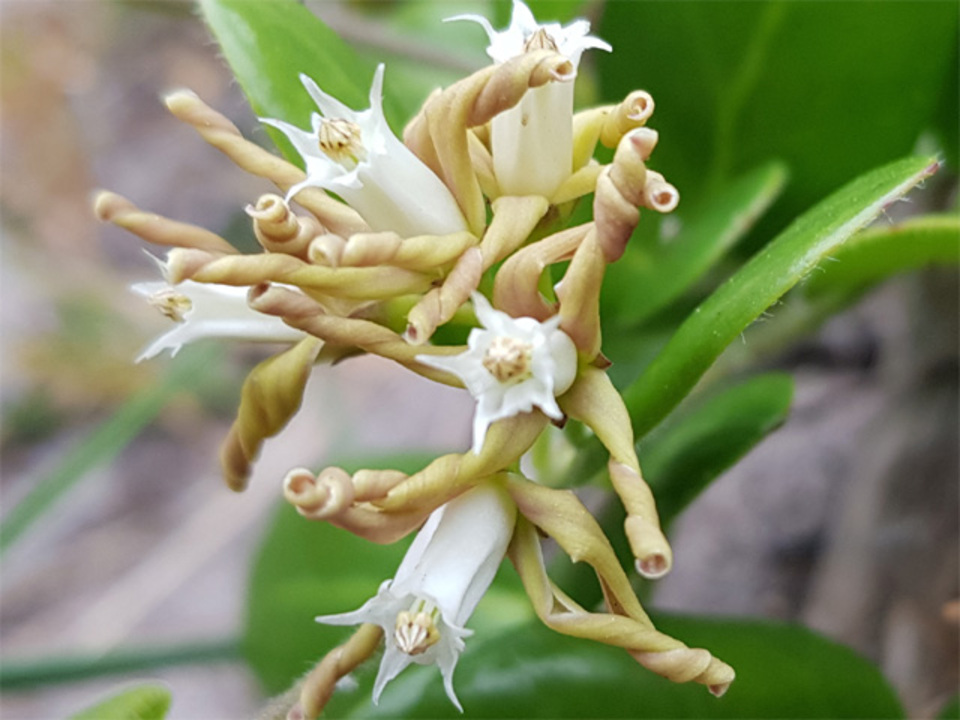
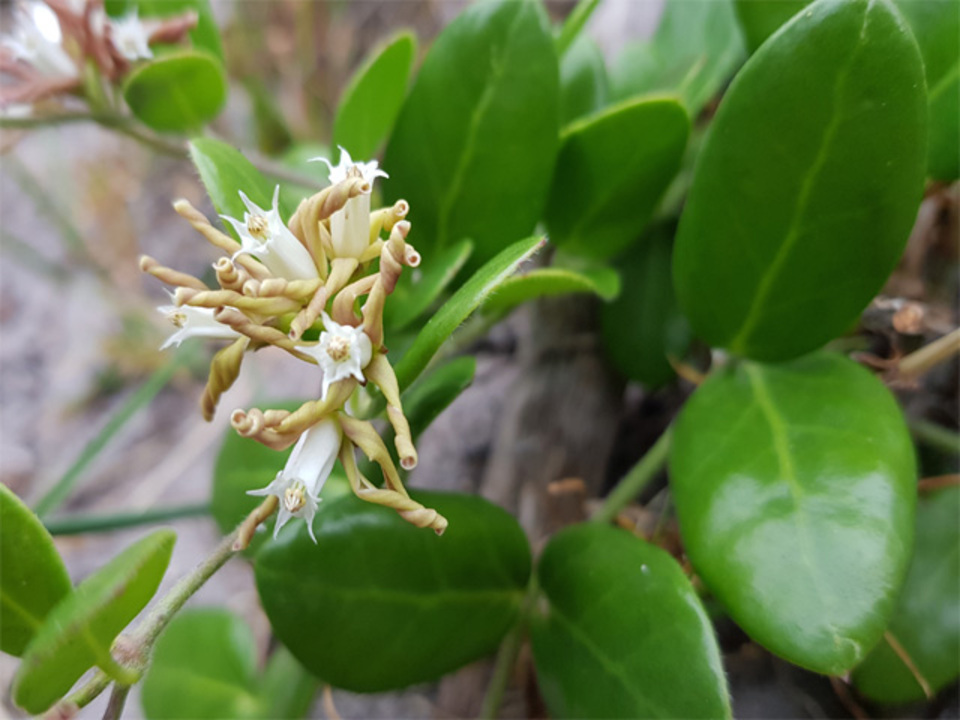
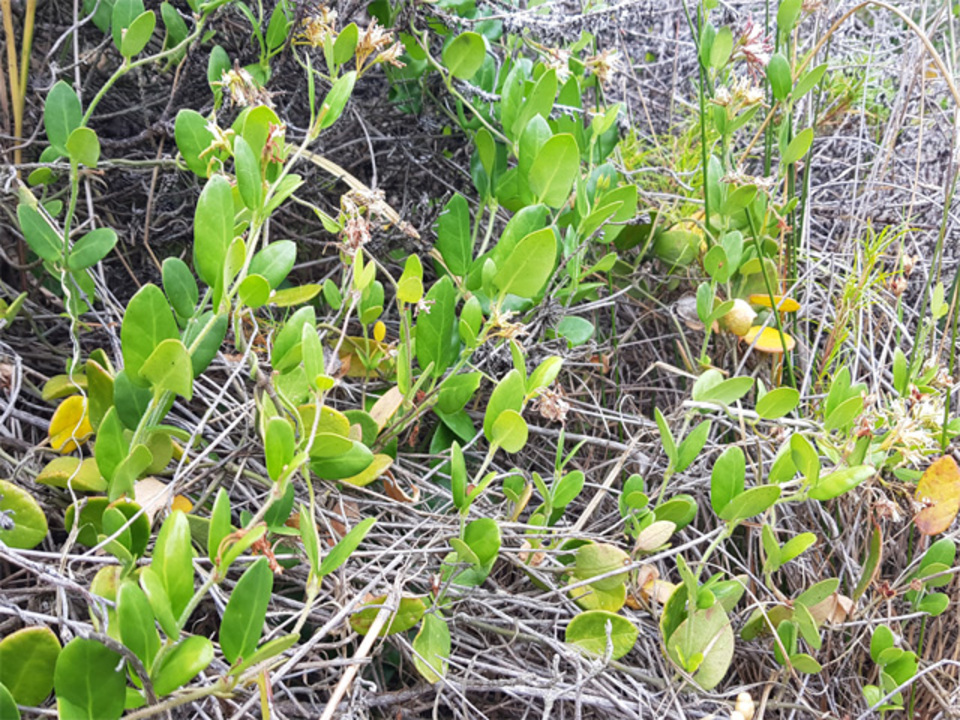
Flora Detail
| Common Name | Cape Buckhorn, klimop or bobbejaantou (Afr.) |
| Family | Apocynacea (Dogbane Family) |
| Date Observed | 14-11-2021 |
| Category | Ground cover |
|---|---|
| Catalogue No. | 1119RGu |
| Flowering Time | Spring,Summer |
| Colour | White to Grey |
| Locations Observed | |
| Estuary | |
| Koppie | |
| Nature Reserve | Few |
| Small Holding | |
| Village | |
| Greater Rooiels | |
Cynanchum africanum
Information
Cape Buckhorn, klimop or bobbejaantou (Afr.)
Cynanchum africanum (also known as klimop or bobbejaantou) is a South African, evergreen, succulent, perennial climber often found in coastal sandy soils, particularly in the Cape provinces. It features slender, sometimes hairy stems, milky latex, and opposite, heart-shaped, fleshy leaves. It produces small, sweetly scented brown or green flowers with a white, tube-shaped crown from June to December, followed by horn-shaped pods containing plumed seeds.
Cynanchum africanum (Bobbejaantou) is a South African endemic, and sometimes hairy perennial climber (up to 1 meter) found in coastal sandy soils of the Cape Provinces. It features opposite, fleshy, heart-shaped leaves, milky latex, and clusters of small, fragrant, brown/white flowers (June–Dec) that produce horn-shaped fruit with plumed seeds.
Key Details
Family: Apocynaceae
Habit: Slender, twining stems and branches
Habitat: Coastal bush/sandy soil
Characteristics: Contains bitter, milky latex
Leaves: Opposite, heart-shaped (cordate), sometimes slightly hairy
Flowers: Small, scented, brown/green with a white corona, in clusters
Fruit: Horn-shaped (follicles)
Distribution: Endemic to South Africa (Eastern, Northern, and Western Cape)
Conservation Status: Least Concern
Toxicity
Cynanchum species are known to contain neurotoxic compounds (cynanchosides) that can cause "krampsiekte" or "cynanchosis" in livestock.
Symptoms of toxicity include nervous system stimulation, tremors, and paralysis.
Identification
It is often confused with or shares similar habitats with Cynanchum ellipticum (also called Bobbejaantou).
It is a significant component of coastal vegetation.
(AI Overview)