Flora Detail
| Common Name | Rope Capespray, Evening gonna, lax gonna, the lady that passes by in the night (Eng.); stroopbossie, juffertjie-roer-by-die-nag, aandgonna, slapgonna (Afr.) |
| Family | Thymelaeaceae |
| Date Observed | 29-07-2021 |
| Category | Shrubs |
|---|---|
| Catalogue No. | 3318RG |
| Flowering Time | Anytime,Spring,Summer,Autumn,Winter |
| Colour | White to Grey |
| Locations Observed | |
| Estuary | |
| Koppie | |
| Nature Reserve | Many |
| Small Holding | Many |
| Village | |
| Greater Rooiels | |
Struthiola ciliata
Information
Rope Capespray, Evening gonna, lax gonna, the lady that passes by in the night (Eng.); stroopbossie, juffertjie-roer-by-die-nag, aandgonna, slapgonna (Afr.)
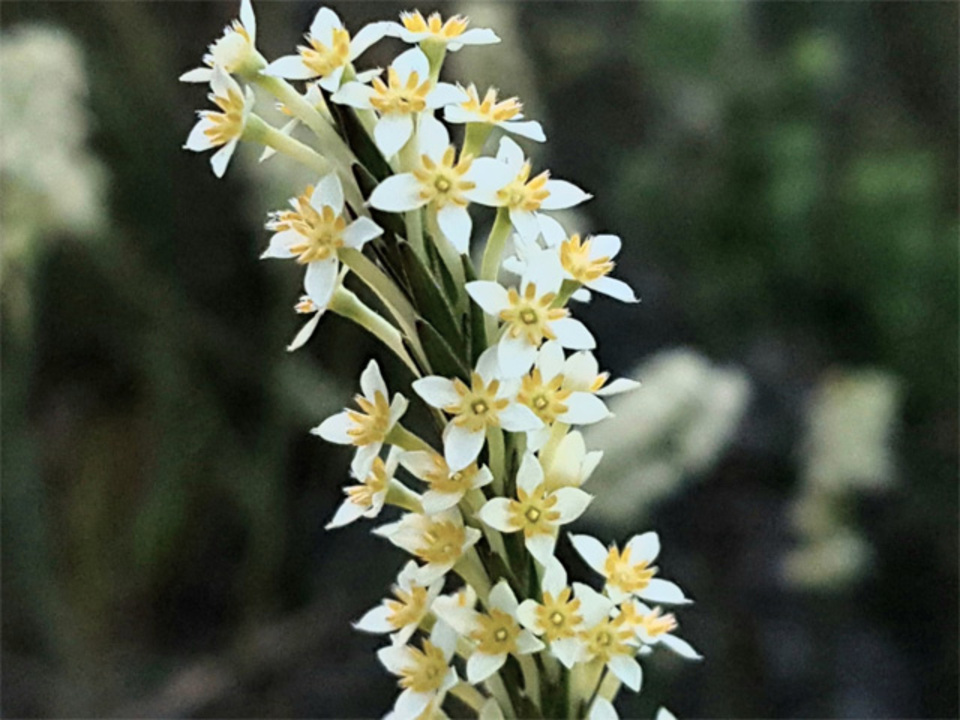
Struthiola ciliata, known as the featherhead or juffertjie-roer-by-die-nag, is a South African fynbos shrublet (up to 1.5m) in the Thymelaeaceae family, characterized by hairy branches and linear-lanceolate leaves. It produces creamy-white, pink, or reddish tubular flowers that are strongly honey-scented at night, attracting moths for pollination.
Key Details for Struthiola ciliata:
Appearance: A small, much-branched shrub (shrublet) with white-woolly tetragonal branches.
Leaves: Opposite, linear-lanceolate, and often fringed with fine hairs.
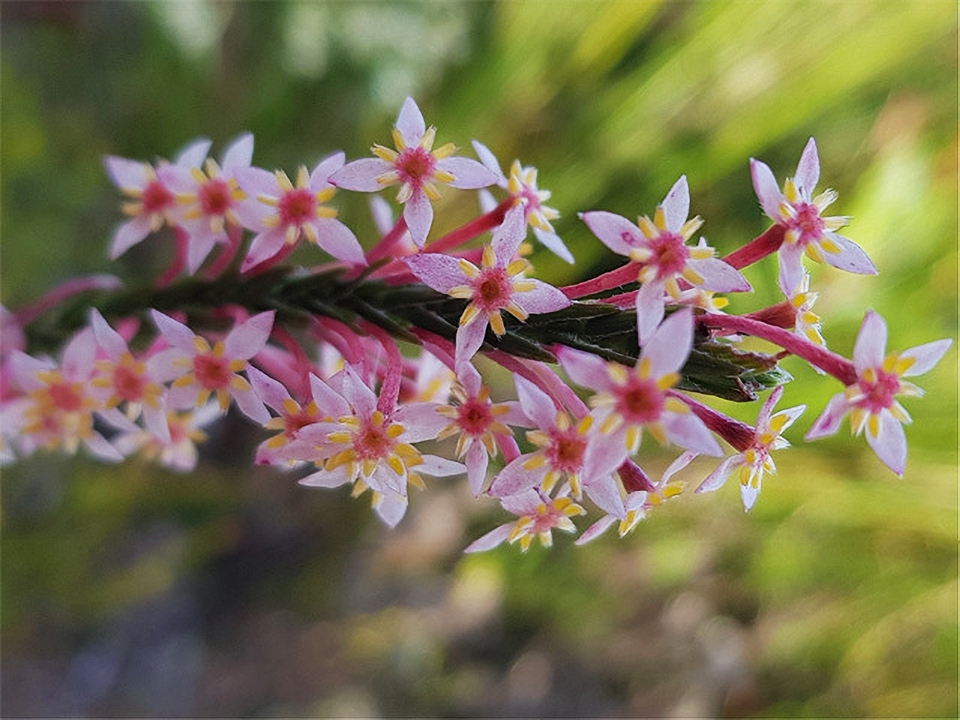
Flowers: The flowers are slender, tubular (about 20mm long), and arranged in spikes. They are creamy white, pink, or reddish, and feature 8 hairy petaloid scales at the mouth of the tube.
Scent: The flowers are notably fragrant at night, releasing a sweet, spicy, or vanilla scent to attract moth pollinators.
Habitat: Commonly found on flats and slopes, particularly in the Southwestern Cape, South Africa.
Flowering Time: Produces flowers throughout the year.
Pollination: It is a key example of moth-pollinated plants in the fynbos, with flowers lasting 9–11 days.
Taxonomy: Belongs to the Thymelaeaceae family, sharing features like 4 stamens and a persistent base of the calyx-tube with other Struthiola species.
It is often found in fynbos vegetation and is well-adapted to the region.
AI Overview