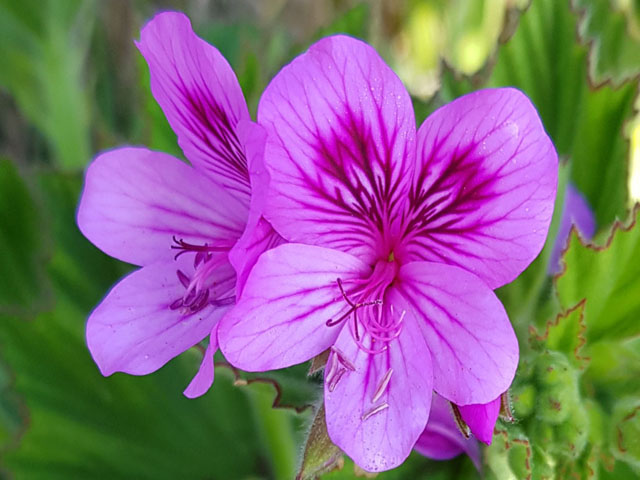
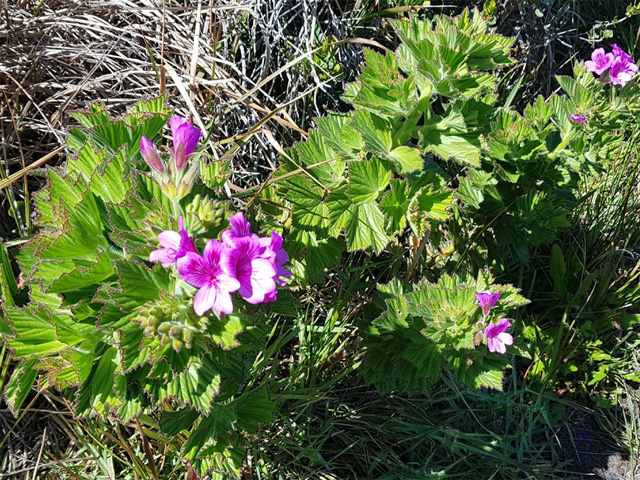
Flora Detail
| Common Name | Hooded Storksbill |
| Family | Geraniaceae (Geranium Family) |
| Date Observed | 20-09-2021 |
| Category | Shrubs |
|---|---|
| Catalogue No. | 3324RG |
| Flowering Time | Spring,Summer |
| Colour | Pink to Mauve |
| Locations Observed | |
| Estuary | Many |
| Koppie | Few |
| Nature Reserve | Many |
| Small Holding | Many |
| Village | Many |
| Greater Rooiels | |
Pelargonium cucullatum
Information
Hooded Storksbill
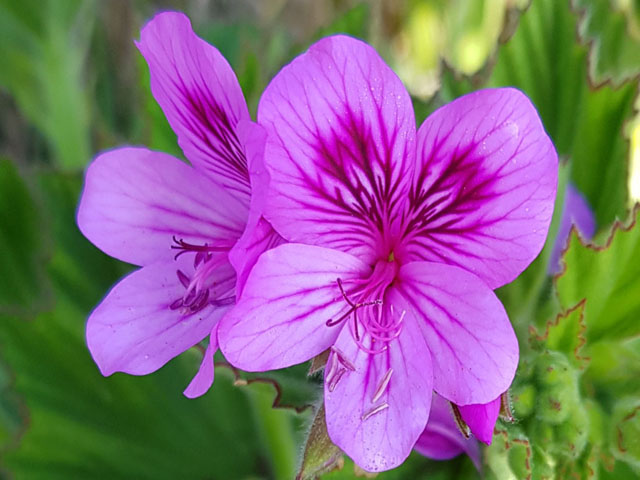
Pelargonium cucullatum is a hairy, upright, branching, perennial shrub, of 1–2 m high, that has been assigned to the cranesbill family. It sprouts new stems from the underground rootstock and becomes woody at its base. It has alternately set, sometimes slightly succulent leaves crowded near the top of the branches, with leaf stalks and flat to hood-shaped leaf blades, with a rounded broad triangular to kidney-shaped outline of about 4–5.5 cm long and 5–9 cm wide, often somewhat incised, the margin with irregular teeth. The white to purplish red, 5-merous, somewhat mirror symmetrical flowers grow in umbel-like clusters, and each contain mostly 7 fertile stamens and 3 infertile staminodes (best checked in the bud) of different length. P. cucullatum has been cultivated as a garden ornamental and house plant since the 17th century. It has been used to breed many modern pelargonium hybrids, notably the Regal pelargoniums. It is called hooded-leaf pelargonium or herba althaea in English and wildemalva in Afrikaans.
Description
Pelargonium cucullatum is a hairy, upright, branching, perennial shrub of 1–2 m high, with a taproots and underground runners from which intermittent shoots arise. It is fragrant when rubbed. The branches are initially herbaceous and greyish green but become eventually woody and brown. These are 6–10 mm in diameter, and have a sparse to dense covering of long, soft (villous) hairs or straight hairs all pointing in the same direction (also called strigose), and some glandular hairs. The alternate leaves are crowding near the ends of branches and are hairy in the same manner as the branches. Each leaf is accompanied by two free, caducous, membranous, light green, ovate to narrowly ovate stipules of 5–10 mm long and 3–7 mm wide with a pointy tip, to the sides of the leaf stem. The leaf stem is mostly 20–55 mm long (full range 8–90 mm, with a groove on the somewhat flattened upper side. The undivided leaf blade is flat to cup-shaped, with a firm to somewhat succulent, rounded, broadly triangular to kidney-shaped outline of about 4–5.5 cm long and 5–9 cm wide, often somewhat incised, the margin with irregular teeth, particularly near the base, occasionally accentuated by a red line or a row of hairs, and a heart-shaped to wedge-shaped base. The veins are sunken below the upper leaf surface but stick out on the lower leaf surface.
Differences between the subspecies
Pelargonium cucullatum subsp. cucullatum has somewhat angularly incised leaves, covered in long soft (or villous) hairs. Subsp. strigifolium also has more or less angularly incised leaves, but these are covered in straight hairs that all point in the same direction (or strigose). Finally, the leaves in subsp. tabulare are not angularly incised, and are villously hairy.